Please feel free to contact me if I can help tell your story or if you have any questions or comments.
ABOUT
GET IN TOUCH
Please feel free to contact me if I can help tell your story or if you have any questions or comments.
ABOUT
A Chat with Author and Filmmaker Steven Fenberg
Houston Lifestyles & Homes
READ a conversation with writer Melanie Saxton about Steven Fenberg’s personal and professional lives.
Steven Fenberg (center) with his husband Harry De Jonge and mother Lenore Fenberg.
BIO
I grew up in Houston, Texas, and spent many happy hours at the nearby Gulf of Mexico and the Brazos River, where I developed my love of the natural world. I also spent countless hours in downtown Houston, where my parents’ first store—Nolen’s Jewelry—was located in a two-floor building built by Jesse Jones in 1914. The 75-floor Chase Tower—Houston’s tallest building—stands there now. I have experienced first-hand Houston’s evolution.
Driving the tractor at our farm in Sandy Point, Texas, in Brazoria County near Houston. My big brother Jay is in front of me in the white t-shirt.
As a teen, I attended concerts at the new gleaming Jesse H. Jones Hall for the Performing Arts and never imagined many years later I would write a book and produce a film about Mr. Jones or about the hall’s profound influence on the performing arts in Houston. I knew little about Jesse Jones until I was hired in 1993 to write a biographical sketch about him for Houston Endowment, the philanthropic foundation he and his wife Mary Gibbs Jones established in 1937. In addition to Mr. Jones’s success as Houston’s preeminent developer during the first half of the 20th century, I discovered as chairman of the federal government’s Reconstruction Finance Corporation (RFC) he initiated and managed many massive New Deal agencies that saved and expanded the nation’s economy during the Great Depression and militarized industry in time to fight and win World War II. Jesse Jones’s pivotal contributions exemplify the power of good government and inspired me to reveal them as models for today.
Our family’s downtown store during the Houston Fat Stock Show and Rodeo parade in the late 1950s. The 70-floor Chase Tower stands there now.
As luck would have it, while I was working on the biographical sketch, Houston Endowment was preparing to move from Mr. Jones’s 1907 Bankers Mortgage Building to the Chase Tower, where my family’s store once stood. I felt like I was going home when I started working at the foundation’s new 64th-floor office in the skyscraper. But back in the empty Bankers Mortgage Building, which at 10-floors was among Houston’s first skyscrapers when it was built, walk-in safes and file cabinets crammed with documents and photographs from Jones’s business empire needed to be organized. I was hired, along with architectural historian Barrie Scardino, to assemble an archive into what became a unique record of Houston’s early business history. The comprehensive collection is now available at Rice University’s Woodson Research Center at the Fondren Library. While assembling the archive, I extracted graphically interesting documents for reproduction and inclusion in a permanent exhibition I was asked to curate and produce for the foundation’s new offices. The exhibition was later duplicated and installed at Rice University’s Jesse H. Jones Graduate School of Business.
Jesse Jones’s 1929 Gulf Building (now the JP Morgan Chase Building) remained Houston’s tallest skyscraper until the 44-story Humble Oil Company Building opened in 1963. Jones’s Bankers Mortgage Company building is to the right of the Gulf Building; the top of his Rice Hotel is on the far right; the top of his Bristol Hotel is in the center; and Jones’s National Bank of Commerce Building is in the bottom right corner. (Photo - Woodson Research Center).
There was more to do to renew knowledge about Mr. Jones, who during the Great Depression and World War II was the most powerful person in the nation next to President Franklin D. Roosevelt. In the mid-1990s, people still lived who knew him, so with Houston Endowment’s support I initiated an oral history program and interviewed family members, past Jones Interests employees, famous merchant Stanley Marcus, economist John Kenneth Galbraith and the children of President Woodrow Wilson’s doctor and closest associate, Admiral Cary Grayson, who was a close friend of the Joneses during World War I. Almost all of the participants have since passed away.
The federal government’s Reconstruction Finance Corporation chaired by Jesse Jones built massive factories during World War II. LIFE magazine reported in 1941, “It is his job to finance the industrial plant expansion for waging war.”
I took the information I gathered and was executive producer and co-writer of Brother, Can You Spare a Billion? The Story of Jesse H. Jones, an Emmy award-winning documentary narrated by Walter Cronkite that was broadcast nationally on PBS. Because only the highlights of Jones’s remarkable story could fit into a one-hour documentary, the biography Unprecedented Power: Jesse Jones, Capitalism, and the Common Good followed. Some joke the only thing left to do about Jesse Jones is a musical.
Steven Fenberg with Walter Cronkite, who narrated Brother, Can You Spare a Billion?, the Emmy Award-winning documentary broadcast nationally on PBS.
Before I began my decades-long adventure with Jesse Jones, I wrote about political, environmental and social issues for magazines and newspapers. As the deadly threat of AIDS emerged, I wrote and produced AIDS: Just Say Know, a short compelling educational play that was performed throughout greater Houston in theaters, community centers, churches and synagogues, and as in-service training for teachers and law enforcement officials, when the disease was in its infancy, misinformation instilled fear in many and resources were unavailable to keep people safe. I was privileged to serve as the volunteer coordinator of AIDS Foundation Houston’s speaker’s bureau in the late 1980s and into the 1990s.
I received a good education in Houston’s public schools and at The University of Texas at Austin, where I graduated with a bachelor’s degree in business. After graduation I participated in my family’s business until I struck out on my own as a full-time writer. Coming from a family of civic-minded volunteers, I served on the advisory boards of the American Red Cross Museum in Washington, D.C., Houston History magazine, AIDS Foundation, Houston, and No More Victims, an advocacy agency for children whose parents are in prison. While still in high school, I formed a social group for special needs teenagers and young adults at the Jewish Community Center of Houston that continues to meet today. I had the honor to serve on Congregation Emanu El’s board of directors, former Mayor Bill White’s task force on Houston’s history and as a trustee of the Aubrey and Sylvia Farb Community Service Fund that helps emerging and small nonprofit organizations support the underserved of Houston.
Exhibit curated and produced by Steven Fenberg in Houston Endowment’s previous headquarters in the Chase Tower.
In 2023, Houston Endowment built its own state-of-the-art headquarters, and I was asked once again to produce and curate a permanent exhibit about the Joneses and the history of the foundation. Even though I have moved to The Netherlands with my husband Harry, I recently wrote a biographical sketch about the Joneses’ beloved granddaughter Audrey Jones Beck for the Museum of Fine Arts, Houston’s new John A. and Audrey Jones Beck Collection catalogue. I have had the privilege of telling stories about one of Houston’s foremost families, about one of the nation’s most powerful and effective public servants and about institutions that help Houston and the nation thrive. I am glad to provide my services to tell meaningful institutional and personal stories no matter where I live.
Interactive exhibit curated and produced by Steven Fenberg in Houston Endowment’s new headquarters.
As a child, I spent many happy hours at my family’s store and explored and enjoyed Jesse Jones’s downtown as if it were my own backyard. My association with Jesse Jones thus did not begin in 1993; as was the case for so many Houstonians of my generation, it began practically at the time of my birth. But now, I am directed by Mr. Jones’s example as a civic leader, public servant, philanthropist and capitalist and by a line from his speech at Southwestern University’s 1925 commencement when he said to the graduates, “It is in service that you will grow the greatest.”
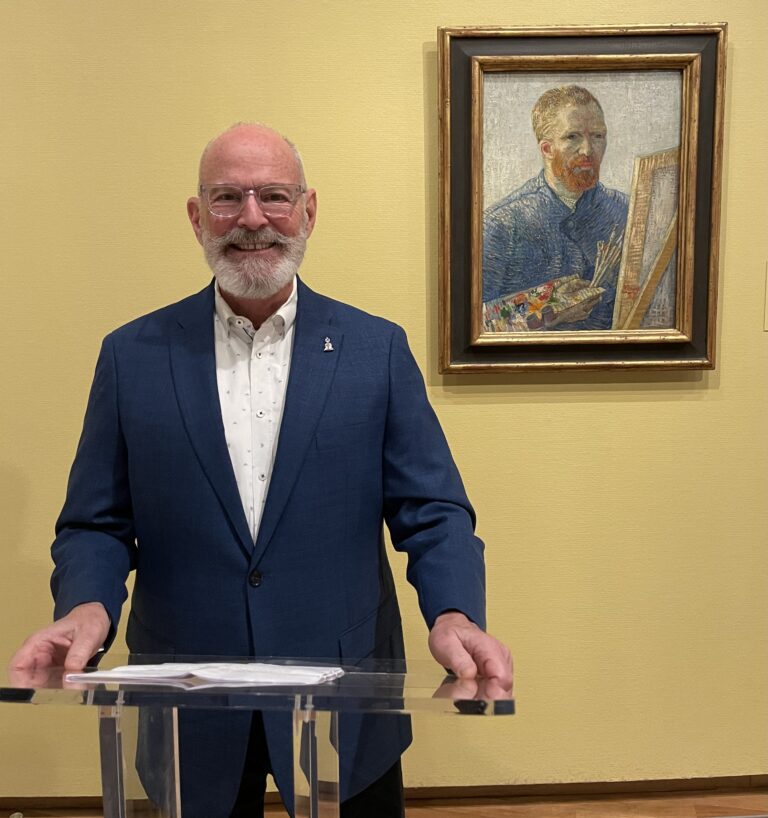
Steven Fenberg speaking at the Van Gogh Museum in Amsterdam about the Beck Collection at the Museum of Fine Arts, Houston, in Texas.